
When it comes to training your dog, you don’t have to make too many expenses just to achieve that desire. Dog training can happen without a trainer’s aid. If you are certain in what you want for your dog to learn, you can certainly do it all on your own. Not only will it be very cost effective on your part, but it will also be something worthwhile as you get to know your dog more and your dog will also recognize your authority more. Also, keep in mind, that when you take your pet to dog obedience classes, the trainer will demonstrate how to train your dog, but you will have to practice the dog training tips at home, so it still requires your time. Read More
Why Punishment should be Avoided
Punishment has been a big part of dog training for a long time, but more recently dog trainers from around the world are shifting away from encouraging “active” punishment, such as shouting, or using physical force to get your way. Nowadays, most dog trainers recommend their clients remain calm in the face of undesirable behaviour from their dogs, and then reinforcing good behaviour.
There are plenty of reasons why dog trainers have moved away from active punishment as a means of training, and these reasons are often well-supported by research into the subject. Because, while punishing dogs for bad behaviour is often very effective in the short-term, its ability to redefine their behaviour, and the state of mind that causes them to behave in that way, seems very limited. Playing the role of “alpha” can be very effective, but there is often very little opportunity for you to relax as a result, because all you’ve achieved is making your dog afraid and anxious about upsetting you, you’ve not taught them good behaviour.
Here are a few of the consequences of punishing dogs, instead of reinforcing them, that have been borne out by research:
- The bond of trust between your and your pet will be damaged.
- Can cause physical harm. Most cases of abuse to dogs aren’t intentional, they happen because the owner doesn’t understand how to treat their animals and they go overboard as a consequence.
- It can elicit a response of fear and anxiety.
- It reduces your dog’s ability to learn.
None of this is to suggest that punishment as whole shouldn’t ever be applicable, or that rules should not be enforced on your pet, but likewise with the restrictions you place on your dog, you should try to restrict the ways in which you punish them to ways that aren’t in trouble of being abusive. It is important that you understand that positive reinforcement of good behaviour can work a lot better to reform behaviour in the long term, and flipping out, or losing your composure, is unlikely to ever be very effective.
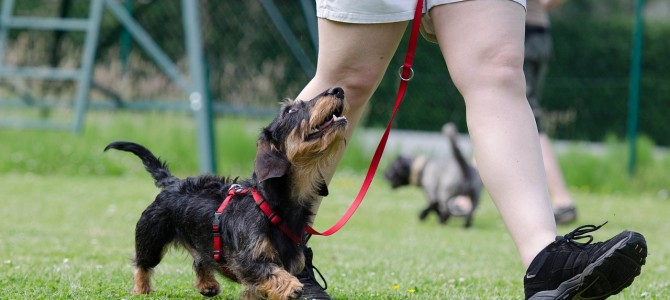
How to Start Training Your Dog
Starting to train your dog is a necessity for every dog owner. Whether this materialises simply as an attempt to potty train them, or a full on attempt to get them obedient and understanding of a wide range of commands, the ideal situation is to start their training as soon as they’re born.
Dog trainers will tell you that, despite their short attention span, puppies which have only just opened their eyes are still capable of learning a number of basic commands, such as “sit”, “Lay down” and “stay”. It is important that you enforce these commands early in their lives, as it will guarantee you a more obedient and ready to learn more pet once they’ve grown up.
Whenever you consider training your dog, you need to understand that dogs are individuals and have varying limitations. You won’t necessarily be able to train a dog to the same high standard as the most well trained dogs, particularly when talking about the difference in intelligence between certain breeds.
Starting Dog Training When They’re Adults
Everybody has heard the old adage, “an old dog can’t learn new tricks”, and there is certainly some accuracy to this saying. The best time to start training a pet dog is when they’re still puppies, or adolescents, but once they’ve reached adulthood, behaviour has started to become engrained in who they are, which means that over-riding their learned behaviour is a lot more difficult.
Even though all of this is true, there are plenty of techniques that you can use which will have more impact than you might expect. If they already are quite obedient dogs in most cases, you may actually find it easier to train an adult dog than a puppy, as they are going to have a better understanding of instructions. Of course, it is also unfair to paint all adult dogs with the same brush, as a dog which is 3 years old is going to have an easier time of learning how to stop a bad habit than a dog which is 10 years old.

The Causes of a Lack of Obedience in Pet Dogs
When you look at the route causes of a lack of obedience in a pet dog, it really comes down to two main areas. The first is the one we’ve just talked about last week; a breakdown in the relationship between you, the owner, and your pet dog. This can be because you don’t really have a good understanding of how to handle the relationship between you and your pet dog, or it could simply be that your current pet dog is just too much of a dominant force for you overcome. This can vary from individual to individual, with both the dogs and the people in the relationship.
The other one is simply that they aren’t leading active enough lives. For a dog to feel happy they need to have a sense of purpose or fulfilment, just like most humans. If your pet isn’t a working animal, you can accomplish this by keeping your pet active; walks, playing, and other physical activities. If your pet isn’t feeling fulfilled then the chances are that they are going to be acting out and developing bad habits. The amount of work that you’ll need to put into giving them this sense of fulfilment can also vary a lot depending upon the breed and the individual animal, with border collies famous for being particularly demanding.